

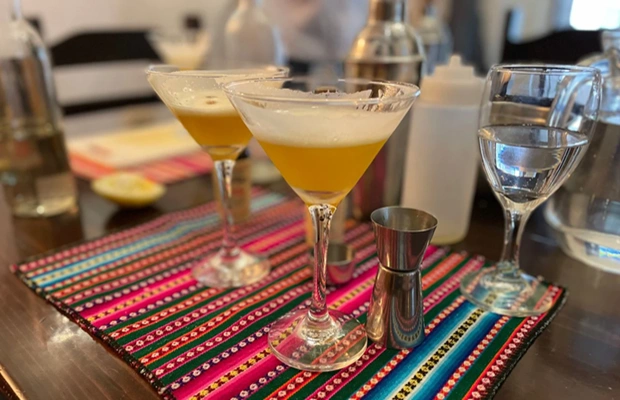
Before you take your first bite of a zesty Peruvian ceviche or a tender alpaca tenderloin in our Cusco cooking classes, there is a sacred hospitality ritual that must be observed. It begins with the rhythmic sound of ice hitting metal inside a cocktail shaker and ends with three aromatic drops of bitters floating atop a cloud of snowy foam. We are talking, of course, about Peru's undisputed national cocktail: The Pisco Sour.
1. What Exactly is Peruvian Pisco? (And What Makes It Unique)
To master the cocktail, you must first understand the spirit. Pisco is a crystal-clear, high-proof grape brandy (typically 38% to 48% ABV) distilled from freshly fermented wine in the sunny coastal valleys of southern Peru. Its name comes from the ancient port town of Pisco in the Ica region—and even further back from the Quechua word Pisqu ("little bird"), a name also given to the pre-Inca clay amphorae (piskos) used to store fermented beverages.
Unlike French Cognac, Spanish brandy, or American whiskey, authentic Peruvian Pisco follows three strict Denominación de Origen laws:
- Distilled to Proof (Zero Water Added): It is distilled only once in copper pot stills (alambiques) directly to bottling strength—not a single drop of water, sugar, or coloring is ever added after distillation.
- Never Aged in Wood: Pisco rests for at least three months in neutral glass, ceramic, or stainless-steel vessels so it never absorbs oak tannins, preserving the pure, vibrant terroir of the grapes.
- Three Main Styles: Pisco Puro (made from a single grape variety, most famously the non-aromatic Quebranta grape or aromatic Italia), Pisco Acholado (a master blender's mix of aromatic and non-aromatic grapes), and Pisco Mosto Verde (distilled from partially fermented must before all sugars turn to alcohol, yielding an ultra-velvety texture).
2. The Roaring Twenties in Lima: Victor Morris & Mario Bruiget
While Peruvian Pisco has been distilled since the 16th century, the Pisco Sour was born in the early 20th century. In 1916, an American expat named Victor Vaughen Morris—who had moved to Peru from Utah to work for the Cerro de Pasco Railway Company—opened Morris' Bar on Calle Boza in downtown Lima. His saloon quickly became the favorite gathering spot for Lima's aristocracy, foreign diplomats, and visiting adventurers.
One evening, running low on whiskey for a traditional Whiskey Sour, Morris substituted Peruvian Pisco alongside key lime juice and simple syrup. The drink was an instant sensation—yet the original version was still missing its signature crown of foam.
"The true magic of the Pisco Sour happened in the 1920s when Peruvian bartender Mario Bruiget perfected the recipe—adding fresh egg white for a silky foam head and Angostura bitters for aromatic balance."
That final stroke of genius came from Mario Bruiget, a talented Peruvian bartender from Chincha working behind the counter at Morris' Bar in the late 1920s. Bruiget introduced fresh egg white to emulsify the cocktail and topped the foam with Angostura bitters. When Morris' Bar closed in 1929, its bartenders took the recipe to Lima’s legendary Hotel Maury and Gran Hotel Bolívar, launching the Pisco Sour onto the global stage.
3. The Anatomy of the Perfect Pisco Sour: The 3-1-1 Ratio
A world-class Pisco Sour relies on an exact balance between strong, sour, sweet, and silky. In our Cusco studio, we teach our guests the classic 3-1-1 bartender's ratio:
- 3 oz (90 ml) Pisco Puro Quebranta (Non-aromatic Quebranta provides a bold, clean structure that allows the citrus to shine).
- 1 oz (30 ml) Freshly Squeezed Key Lime Juice (Limón Sutil): Squeezed gently to avoid the bitter oils in the green peel.
- 1 oz (30 ml) Simple Syrup (Jarabe de Goma): A 1:1 or 2:1 sugar-to-water syrup.
- 1/2 oz (15 ml) Fresh Egg White (Or 1 oz chickpea aquafaba for a 100% vegan version).
- 4 to 5 Large Ice Cubes (Solid cubes chill the drink quickly without over-diluting).
- 3 Drops of Angostura Bitters: Dotted onto the center of the white foam to neutralize the aroma of the egg white and add warm notes of cinnamon and clove.
4. The Bartender's Secret: The "Dry Shake" Technique
Why do homemade Pisco Sours often lose their foam after a minute, while bar-quality sours hold a thick, meringue-like head until the last sip? The secret is the Two-Step Shake:
- The Dry Shake (Without Ice – 10 Seconds): Combine the Pisco, lime juice, simple syrup, and egg white in the shaker without ice and shake vigorously. Without cold ice constricting the proteins, the egg white whips into a dense, velvety emulsion.
- The Wet Shake (With Ice – 8 Seconds): Add 4 to 5 solid ice cubes and shake hard for just 8 seconds to chill the cocktail to freezing temperature, then double-strain into a chilled glass.
5. The Modern Favorite: The Passion Fruit (Maracuyá) Sour
While the classic key lime Pisco Sour is a timeless icon, Peru's extraordinary biodiversity of exotic Amazonian and Andean fruits has inspired mouthwatering modern variations. The reigning favorite across Cusco is the Passion Fruit Pisco Sour (Maracuyá Sour). Substituting fresh Peruvian maracuyá juice for lime creates a vibrant golden-hued cocktail bursting with tropical tang and floral aroma—and it is the very first recipe you will shake yourself when you step into our studio!
Step Behind the Bar & Shake Your Own Pisco Sour in Cusco!
Ready to master the "dry shake" in person? Every session of our Lunch & Dinner Cusco Cooking Classes—as well as our evening Cusco Street Food Walking Tour—includes a hands-on Pisco Sour workshop in our colonial studio!
